Stillness at a Thousand Miles Per Hour: The Inner Calm Mushers Carry Across the Yukon
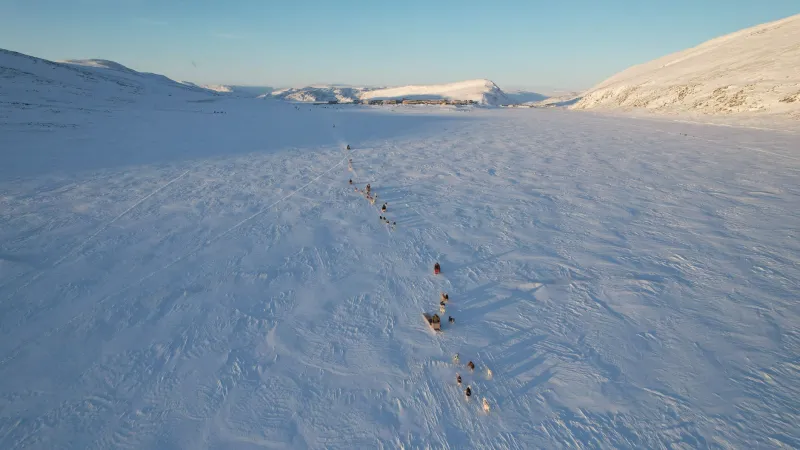
The Yukon Quest is not a race that invites relaxation. A thousand miles of frozen wilderness, temperatures that can plunge past -50°C, overflow ice that appears without warning, and a dog team counting on your every decision — it's the kind of event that sounds like a sustained panic attack dressed in a bib number. And yet, talk to the mushers who keep coming back year after year, and a different story starts to surface. Somewhere between Whitehorse and Fairbanks, many of them find something unexpected: a kind of peace.
It sounds like a contradiction. But in a sport built on chaos, the search for stillness might be one of the most underrated competitive edges on the trail.
The Noise Before the Quiet
Anyone who's stood at the start line in Whitehorse knows the energy is electric. Dogs barking, handlers scrambling, crowds cheering, cameras rolling. The first hours of the race carry a frantic momentum — your body is flooded with adrenaline, your mind is running checklists, and the trail is demanding your full attention.
But somewhere around hour twelve, or maybe hour twenty, something shifts.
Veteran mushers describe a settling that happens once the noise of the start fades and the rhythm of the dogs takes over. The trail stretches ahead. The stars come out. The only sounds are the swish of runners on packed snow and the breathing of your team. For many racers, that's when the race truly begins — not just physically, but mentally.
"The first day, your brain is everywhere," one multi-time Quest finisher explained during a post-race debrief at a Whitehorse community event. "By the second night, if you let it, your mind gets really quiet. You stop thinking in sentences. You just... watch."
Checkpoints as Reset Buttons
For a lot of mushers, the mandatory rest stops scattered across the Quest trail serve a dual purpose. Yes, they're logistical necessities — time to feed the dogs, check paws, grab a meal, and sleep if the body will allow it. But experienced racers have learned to treat them as something more deliberate: a chance to reset the mental state before heading back into the wilderness.
Rituals vary widely. Some mushers journal. Others sit quietly with their dogs, running hands along each animal's body not just to check for injuries but as a kind of grounding exercise. A few describe breathing practices they've developed over multiple races — nothing fancy, just a conscious effort to slow down and check in with themselves before the trail swallows them again.
One Yukon-based musher who has competed in both the Quest and the Iditarod noted that she started treating checkpoint arrivals like a meditation prompt after a particularly rough race several years ago. "I was making bad decisions because my head was full of static," she said. "Now I have a sequence. Feed the dogs, check the dogs, eat something, sit with them for ten minutes and just breathe. That ten minutes changes everything about how I run the next stretch."
The Paradox of Productive Emptiness
There's a concept in sports psychology sometimes called "the quiet eye" — a state of focused calm that high-performing athletes access under pressure, where the mind isn't blank but is operating with a kind of effortless clarity. Coaches in hockey, skiing, and biathlon have studied it for years. Out on the Quest trail, mushers are stumbling into something remarkably similar, often without any formal framework to describe it.
The isolation of the race is a big part of what makes it possible. Unlike most competitive sports, there's no crowd noise, no coach in your ear, no teammate to defer to. It's you, your dogs, and several hundred kilometres of boreal forest or exposed ridgeline. That solitude, which can feel crushing in the wrong mental state, becomes generative when a musher learns to lean into it.
"You figure out pretty quickly that fighting the silence doesn't work," said one Alberta-born musher who relocated to the Yukon specifically to train for the Quest. "The race is so long that if you spend the whole time grinding mentally, you'll fall apart. You have to find a way to be comfortable with just being out there."
For Canadian athletes especially, there's something culturally resonant about this relationship with the land. The idea that wilderness demands a different kind of presence — slower, more attentive, less transactional — runs deep in this country's relationship with its northern geography.
Dogs as Anchors
Ask most mushers what helps them stay centred during the hardest stretches of the race, and the answer almost always circles back to the dogs.
There's a reason the Yukon Quest's identity is inseparable from the human-canine bond at its core. These aren't just athletes an musher is managing — they're partners who communicate constantly, whose moods and energy levels reflect the state of the team in real time. Paying close attention to the dogs forces a musher out of their own head and into a shared, present-tense awareness.
"When I'm spiralling mentally, I look at my leaders," one veteran racer explained. "They're not thinking about what happened two hours ago or what's coming in six hours. They're just running. It snaps me back."
This quality of attention — watchful, responsive, grounded in the immediate — is something long-distance mushers develop over years of training. By the time they're running the Quest, it's become a kind of moving meditation practice, even if they'd never use that language.
Silence as Strategy
It might seem soft to talk about inner calm in the context of one of the world's toughest sled dog races. But the mushers who've stood on that podium in Fairbanks will tell you the mental game is as decisive as any gear choice or training plan.
The Quest doesn't just test how fast you can move through the wilderness. It tests who you are when everything is stripped away — the comfort, the noise, the distraction. The racers who learn to find stillness in that stripped-down state aren't checking out. They're tuning in more precisely than most athletes ever have the chance to.
Out on the trail, somewhere between the Dawson City checkpoint and the long run into Alaska, there are mushers moving through the dark in a state of quiet that most people never access in a lifetime. The chaos is still there — the cold, the risk, the relentless forward motion. But they've found the eye of it.
And that, more than any single piece of equipment or training regimen, might be what carries them home.