Against All Odds: Four Mushers Who Refused to Let the Quest Beat Them
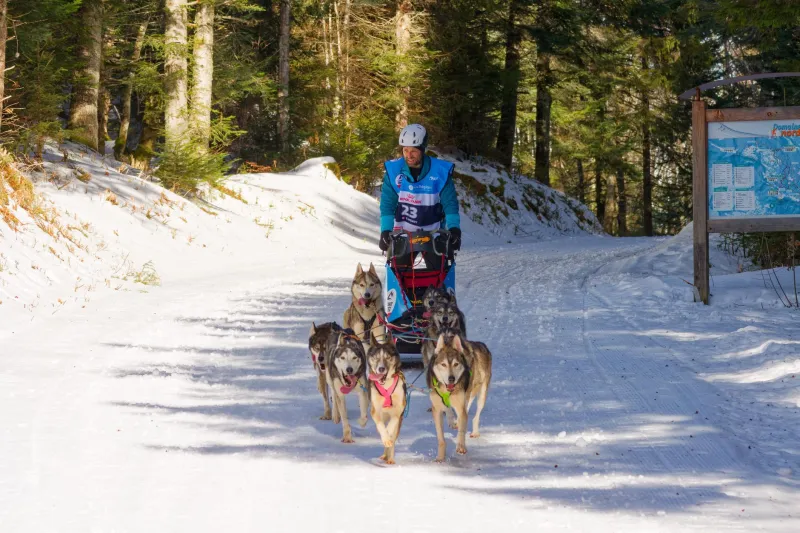
The Yukon Quest doesn't care about your backstory. It doesn't soften for first-timers, doesn't slow down for bad weather, and certainly doesn't reward good intentions. The trail is what it is — 1,600 kilometres of river ice, mountain passes, and darkness that gets into your head and stays there. Finishing it, for the first time especially, is not a given. It's an achievement that most people who attempt it will tell you changed something fundamental about who they are.
These are four of those people.
Marie-Ève Tremblay: The Teacher from Abitibi Who Learned on the Trail
Marie-Ève Tremblay grew up in Abitibi-Témiscamingue in northern Québec, about as far from the Yukon as you can get while still being in Canada. She discovered mushing in her late twenties through a friend's recreational team and spent several years running shorter races in Québec and Ontario before deciding, somewhat impulsively by her own admission, to enter the Quest.
"I didn't have the right dogs. I didn't have enough money. I didn't have a sponsor," she says now, laughing in a way that suggests she's still a little amazed at herself. "I had a team I believed in and a stubbornness that my mother always said would either save me or get me into serious trouble."
She arrived in Whitehorse two weeks before the race start with a second-hand sled, a borrowed handler, and a team of twelve dogs that most observers quietly wrote off. What happened over the next two weeks on the trail became one of the more quietly remarkable finishes in recent Quest memory.
The key moment came on the climb through the Dawson Range, when two of her lead dogs developed minor foot issues and she was forced to reorganize her team configuration in the dark, in temperatures below minus forty, at a spot on the trail with no checkpoint for hours in either direction. She spent ninety minutes working by headlamp, methodically bootying feet, reassessing her lineup, talking to her dogs the entire time.
"I wasn't scared. I was focused. And I think that's when I knew I was going to finish," she says. "Not because everything was going well — it definitely wasn't — but because I realized I knew what to do. The trail had been teaching me the whole time and I'd been listening."
She crossed the finish line in Fairbanks in fourteenth place. She cried for about forty-five seconds, she estimates, and then went to take care of her dogs.
Daniel Tootoo: Running for His Community
Daniel Tootoo is from a small community in the Northwest Territories and comes from a family with deep ties to working dog culture. His grandfather used dog teams for travel and hunting. His father remembers the transition to snowmobiles. Daniel came back to dogs in his thirties as a deliberate act of cultural reclamation.
"There's a generation of knowledge that almost got lost," he explains. "I wanted to reconnect with that. Racing the Quest was part of it, but it was never just about racing."
His path to the start line took six years of building his kennel from scratch, learning from elders in his community who still remembered the old ways of reading dogs and trail conditions, and supplementing that traditional knowledge with modern training methods. He entered the Quest with a team that reflected both worlds — dogs bred for cold-climate endurance in the older tradition, trained with contemporary nutritional science and conditioning protocols.
The race tested him in ways he hadn't fully anticipated. A brutal stretch of overflow ice near the Yukon River crossing cost him hours and left him questioning whether to continue. He stopped, made camp, slept for four hours, and woke up with clarity.
"My grandfather never quit because the ice was bad. He figured it out and kept going. I thought about that a lot out there."
He finished the race and spent much of the following year visiting schools in his home region, talking to young people about sled dog culture, the Quest, and what it means to carry knowledge forward.
Petra Halvorsen: The Late Starter Who Outran Her Own Doubts
Petra Halvorsen entered her first Yukon Quest at fifty-three years old, making her one of the older first-time entrants in the race's recent history. A retired physiotherapist from outside of Calgary, she had taken up mushing after her kids left home and found in it something she hadn't expected: a sense of physical and psychological challenge that her previous life hadn't offered.
"People were polite about it," she says of the reaction when she announced her intention to race. "But I could tell what they were thinking. That I was too old, that my team wasn't competitive, that I was in over my head."
She wasn't wrong that the odds were steep. Her team was solid but not deep, and she'd had limited experience racing in truly extreme cold. The first three days of the race were, by her description, "a masterclass in humility." She ran too fast early, made a navigation error that cost her two hours, and arrived at her first major checkpoint exhausted and rattled.
What turned things around was a conversation with a veteran musher who was also resting at the checkpoint. He didn't offer sympathy. He offered strategy — specific, practical advice about pacing and dog management that she hadn't considered. She adjusted her approach entirely and ran a fundamentally different race from that point forward.
"The Quest community is strange and wonderful," she reflects. "You're competing against these people and they're also helping you survive. There's nothing else like it."
She finished with all her dogs healthy and has since become a mentor to new mushers in southern Alberta, paying forward exactly the kind of advice that kept her in the race.
Théodore Bélanger: When Finishing Is Winning
Théodore Bélanger, a carpenter and part-time wilderness guide from outside of Whitehorse, entered the Quest after a decade of watching it from the sidelines as a volunteer. He knew the trail better than most competitors before he ever ran it — he'd worked checkpoints, helped with logistics, and spent countless hours talking to mushers about their experiences.
Knowing the trail intellectually and surviving it are, as he discovered, entirely different things.
At the midpoint of his first Quest, Théodore was running on virtually no sleep, two of his strongest dogs had been dropped at previous checkpoints due to minor injuries, and the weather had turned genuinely dangerous. Race officials at one checkpoint quietly suggested he consider scratching.
"I thought about it," he admits. "For about ten minutes I thought about it seriously. And then I looked at the dogs I had left and I thought — they're ready to go. They're not asking to quit. So who am I to quit for them?"
He ran the final third of the race with a reduced team, slower than he'd hoped, but deliberate and careful. He reached the finish line late on a Thursday night to a small crowd of family, volunteers, and a handful of fellow mushers who'd waited up to see him come in.
"It wasn't a winning time. I wasn't close to the front. But I've never felt more like I'd actually won something in my life."
The Quest has a way of redefining what winning means. For these four mushers, and for the dozens like them who cross that finish line every year without fanfare or podiums, the real victory was always something the standings can't measure.