Paws and Protocols: The Vets Who Keep the Quest Honest
Dr. Mara Thiessen has pulled all-nighters in a lot of places. Emergency clinics in Calgary. A rural practice in northern British Columbia where she once treated a moose that had wandered into someone's barn. But nothing, she'll tell you, quite prepares you for your first checkpoint shift on the Yukon Quest.
"You're working in temperatures that make your stethoscope stiff," she said, laughing a little at the memory. "You've got a headlamp, a team of sixteen dogs that just ran a hundred kilometres, and a musher who hasn't slept in two days watching your every move. And you have to be completely sharp."
Thiessen is one of roughly two dozen volunteer veterinarians who staff the Quest each year, stationed at checkpoints from Whitehorse to Fairbanks. They are, in many ways, the race's conscience — the professionals whose sign-off determines whether a dog continues on the trail or gets scratched from competition. Their decisions are final. And in a race this demanding, those decisions come fast.
Who Are These People?
The vet corps of the Yukon Quest is a self-selecting group. You don't stumble into this gig. Applicants need a valid veterinary licence, experience with canine athletes or northern working dogs, and — perhaps most importantly — a genuine tolerance for extreme cold and sleep deprivation.
Many are small-animal practitioners who have developed a parallel expertise in canine sports medicine. Others come from large-animal or mixed practices, drawn by the challenge of working in genuinely austere conditions. A handful are Canadian academics with research interests in exercise physiology or cold-weather adaptation in dogs.
What they share is a commitment to a principle that sits at the heart of modern competitive mushing: the dog comes first. It sounds simple. Enforcing it, checkpoint by checkpoint, across a thousand miles of wilderness, is anything but.
"Every musher I've worked with wants their dogs to be healthy," said Dr. James Ookpik, a veterinarian from the Northwest Territories who has volunteered with the Quest for several years. "But they're also competitors. They're tired, they're emotional, and sometimes they need someone on the outside to say, 'This dog needs to stay here.' That's our job, and we don't apologize for it."
What Actually Happens at a Checkpoint
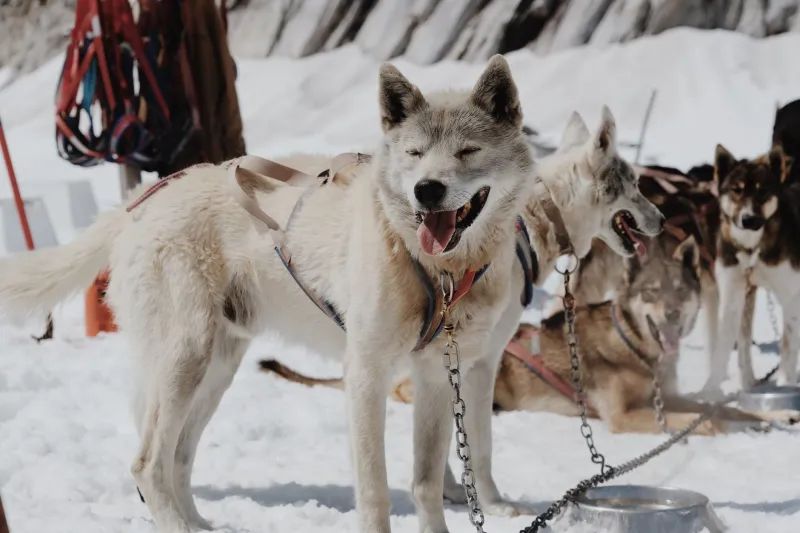
When a team arrives at a checkpoint, the clock doesn't stop for the dogs. Veterinary assessment begins almost immediately. Each dog is examined individually — heart rate, respiratory rate, hydration, gait, paw condition, muscle soreness, body weight relative to their pre-race baseline. The vets are looking for anything that suggests a dog is struggling beyond the normal demands of hard exercise.
Paw care is a particular focus. Hundreds of miles of varied trail — ice, overflow, wind-packed snow, rough glare ice — can be brutal on feet. Vets check for cuts, abrasions, swelling, and signs of cold injury. Mushers apply booties as a first line of defence, but the checkpoint exam catches what the booties miss.
Shoulder and wrist injuries are another common concern. The repetitive motion of pulling, combined with the occasional stumble on rough terrain, puts real stress on a dog's musculoskeletal system. Vets palpate muscles and joints with practised hands, looking for the kind of subtle guarding or asymmetry that signals something worth watching.
If a dog is pulled from the race — "dropped" in Quest terminology — it stays at the checkpoint in the care of designated handlers until it can be transported back to Whitehorse or Fairbanks. The musher continues without that animal. Lose too many dogs to injury or illness, and you can no longer field a legal team. The race is over.
How the Science Has Evolved
The veterinary protocols used in today's Yukon Quest look very different from what existed in the race's early years. When the Quest launched in 1984, the field of canine sports medicine was still relatively young. Checkpoint exams were less standardized, baseline data on racing sled dogs was limited, and the understanding of how dogs respond to sustained Arctic exertion was largely anecdotal.
Decades of research — much of it driven by events like the Quest and the Iditarod — have changed that substantially. Vets now work with detailed pre-race health profiles for each dog. They understand the metabolic demands of running in extreme cold, the early signs of exercise-induced conditions like gastric stress or cardiac arrhythmia, and the specific ways that dehydration presents differently in working dogs than in pets.
"We know so much more now about what a healthy racing dog looks like versus a dog that's in trouble," Thiessen explained. "The baselines we have, the research that's been done — it genuinely makes us better at this. We catch things earlier. We intervene sooner."
That evolution has had ripple effects across the broader mushing community. Standards developed for elite-level racing have filtered down to recreational mushers, sprint racers, and dryland trainers. Veterinary education programs in Canada and the U.S. have incorporated canine sports medicine more formally into their curricula, partly in response to the visibility that races like the Quest have given the field.
The Hardest Calls
Ask any Quest vet about the hardest part of the job, and the answer is almost always the same: the grey areas.
A dog with a minor paw laceration that's healing well. A dog who tested slightly elevated on a cardiac check but is bright-eyed and eating enthusiastically. A dog who the musher insists is fine, and who by most objective measures is fine — but something feels off.
"You develop intuition over time," Ookpik said. "And you have to trust it, even when you can't fully articulate it in clinical terms. Because the alternative is letting a dog continue when maybe they shouldn't. And that's not a risk I'm willing to take."
The relationship between vets and mushers is, by most accounts, a respectful one — even when it's tense. Elite competitors understand that the veterinary team is not the enemy. Most have been in the sport long enough to have seen what happens when warning signs get ignored, and they've internalized the values that the Quest's animal welfare protocols are designed to protect.
But the emotional weight of dropping a dog — particularly for a musher who has trained that animal for years and built a genuine bond with them — is real. The vets feel it too.
"These aren't just athletes to me," Thiessen said. "They're individuals. I know their names by the end of a checkpoint shift. And when I have to pull one, I want the musher to know I'm not doing it lightly."
That care — quiet, unglamorous, and absolutely essential — is what keeps the trail honest. And in a race that demands everything from everyone on it, that's no small thing.